Robotics, Vision and Intelligent Technologies
Work with us
Close

Contact

Universidad de Alicante

Escuela Politécnica Superior III
Ctra. San Vicente, S/N
E-03690 San Vicente del Raspeig (Alicante)
SPAIN

german.gonzalez@ua.es

TEACH-AI: Teaching Evaluation and Adaptive Classroom Hybrid with Artificial Intelligence

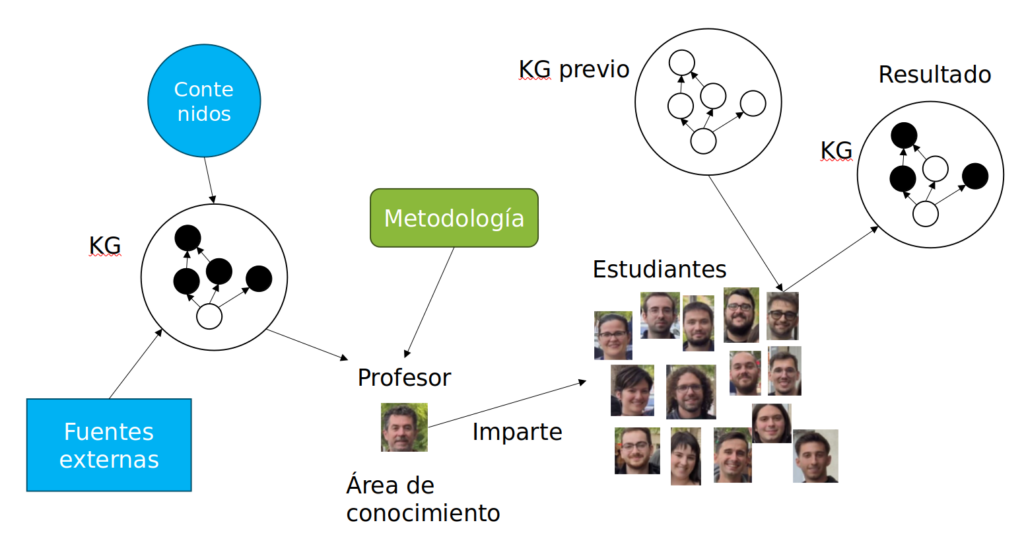
The TEACH-AI (Teaching Evaluation and Adaptive Hybrid Classroom with Artificial Intelligence) project aims to design, develop and validate an Intelligent Digital Twin Classroom system, namely an intelligent simulation environment capable of recreating various teaching-learning contexts and predicting their outcomes.
This system will integrate advanced Artificial Intelligence (AI) models with established pedagogical frameworks to automatically assess how different combinations of curriculum components, teacher profiles and student profiles influence the teaching-learning process. Various educational contexts will be explicitly considered with the aim of assessing each learning situation based on a combination of: heterogeneous student profiles, including students with specific educational support needs (e.g., with Autism Spectrum Disorder (ASD) or Attention-Deficit/Hyperactivity Disorder (ADHD)), teacher profiles (according to variables such as age, gender, skills, among others), methodologies (both expository and active), skills to be developed (knowledge, abilities, attitudes, and values), and assessment to be applied (including initial, formative, and summative).
This will enable us to have Digital Twin Classrooms for various purposes: a) intelligent simulator for teacher training based on various variables: initial training/continuing training (including reskilling and upskilling), educational level (university or non-university), branch of knowledge; b) intelligent simulator for the development of teaching-learning processes based on various variables: face-to-face/distance learning environment, synchronous/asynchronous environment; c) intelligent simulator aimed at student diversity: students with/without specific educational support needs (e.g., ASD/ADHD); d) a “macro” intelligent simulator, where the input consists of official curricula, new projects or educational policies from the Administration, mass assessment results (such as PISA), among others. Based on the design, development and evaluation of each simulation of a teaching-learning context, using parameters constructed so that multiple AI agents interact in the simulation, intelligent models of teaching and organisational configurations will be obtained, classified according to their greater or lesser probability of success and risk of exclusion.
On the other hand, it will be possible to use the system as a simulation-based learning environment, so that any teacher can interact with the system. In this case, the intelligent agent acting as a teacher gives way to the real teacher. This turns the TEACH-AI system into an intelligent simulator that mimics a real-life process or situation and allows teachers to test their hypotheses about the effects of input variables on expected outcomes. This environment can be used by various types of teachers, both university and non-university, and even by future teachers.

Funding and Acknowledgements

This project has been supported by  Generalitat Valenciana